

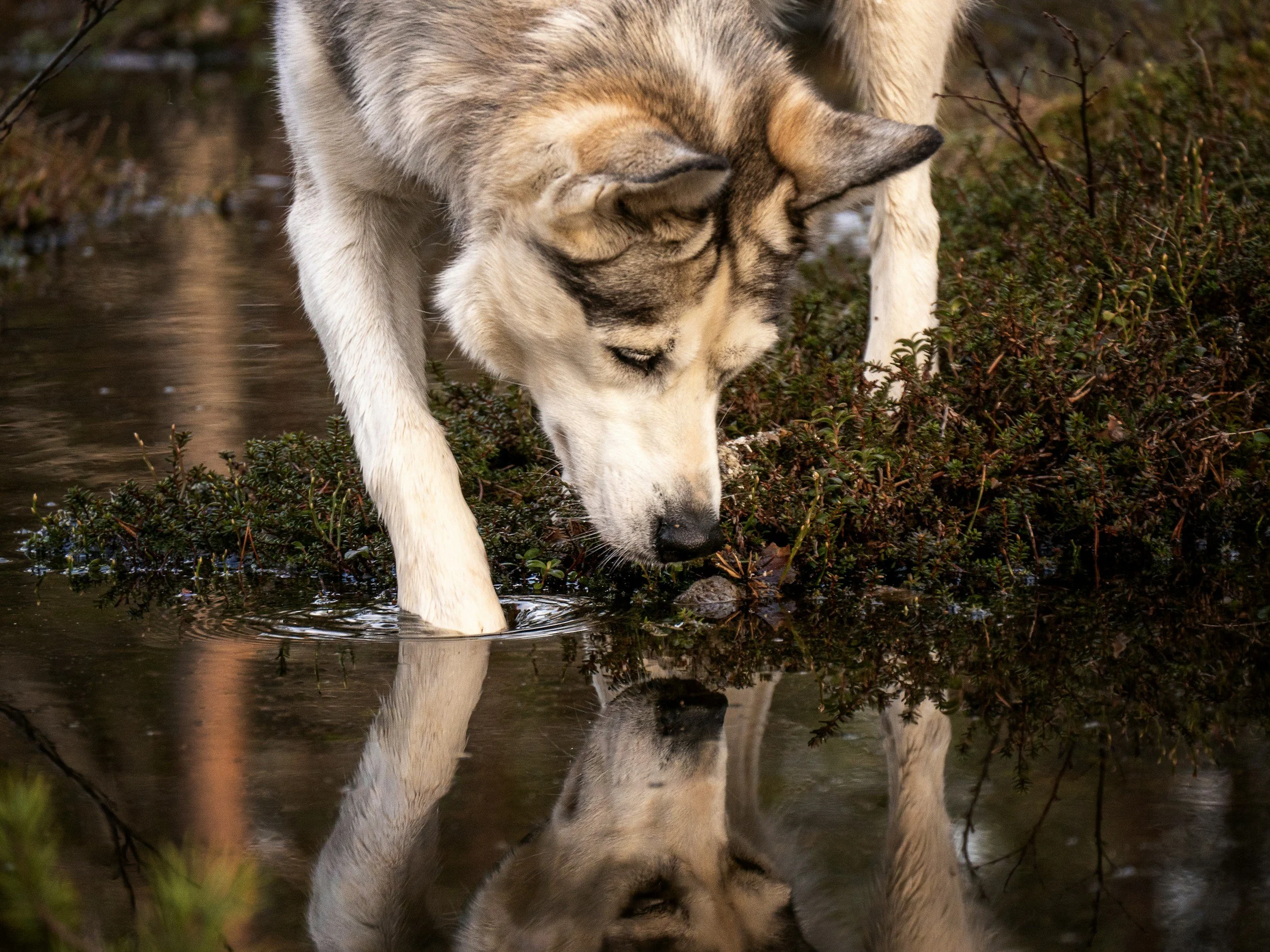
What if our fear of seeing ourselves in other animals is stopping us from seeing them at all?
Anthropomorphism is the attribution of human characteristics, emotions or intentions to nonhuman beings. It's what we're doing when we describe a dog as dramatic, a cat as spiteful or a horse as stubborn.
In many dog training circles, it's also something of a dirty word.
Suggest that your dog is feeling guilty, deliberately ignoring you or plotting revenge, and there's a good chance someone will tell you to stop anthropomorphising. The concern is that we're projecting our own thoughts and feelings onto animals, rather than understanding them for who they are. And this concern is reasonable. Assuming a dog has destroyed the couch to punish you for leaving them home alone can lead to some pretty unhelpful responses.
But I've also become increasingly uncomfortable with how readily we dismiss people's interpretations of animals as anthropomorphic. Particularly when those interpretations emerge from years of living alongside them, observing them and developing relationships with them.
In our efforts to avoid projecting human experiences onto other animals, have we become too willing to dismiss the knowledge that comes from our relationships with them?
The problem with seeing ourselves everywhere
Anthropomorphism is a perfectly ordinary feature of human thinking. We complain that our computers are being difficult, accuse the weather of conspiring against us and sometimes plead with our cars to make it up a steep hill.
Psychologists Epley, Waytz and Cacioppo (2007) suggest that anthropomorphism draws on our knowledge of humans, our motivation to understand other beings and our desire for social connection. When we're trying to understand another animal, our own experiences provide a natural starting point. We know what fear feels like, what it means to seek comfort, and what it's like to experience frustration or excitement. When we recognise familiar behaviour in another animal, we draw on that knowledge.
And this can sometimes lead us astray. One example of this can be seen in research by Horowitz (2009), which challenged the familiar interpretation of a dog's 'guilty look'. Dogs displayed more of these supposedly ‘guilty’ behaviours when their guardians scolded them, regardless of whether they'd actually ignored an instruction. What looks like remorse may instead be a response to an unhappy human.
It’s a useful reminder that our interpretations can be wrong, sometimes with serious consequences for the animals involved. But there's a difference between recognising that we sometimes misunderstand animals and assuming that our emotional understanding of them is inherently unreliable.
The knowledge that comes with knowing
Anthropologist Kay Milton offers an interesting alternative to the usual discussion of anthropomorphism. In her 2005 essay, Anthropomorphism or Egomorphism?, Milton proposed the concept of egomorphism. Rather than attributing human characteristics to other animals, she suggested that we may recognise something of ourselves in them as fellow individuals.
There's an important distinction here. Recognising fear, affection or frustration in another animal doesn't necessarily mean we're imagining them as human. It may mean we're recognising experiences that aren't exclusively human in the first place.
Think about a dog you've lived with for years. You know their habits, their preferences, the subtle changes in their behaviour that tells you something isn't quite right. You can often recognise when they're worried, excited or seeking reassurance before they've done anything particularly obvious. That understanding, that knowing, is developed through thousands of interactions, shared experiences and moments of paying attention.
We readily accept that this kind of familiarity can help us understand other humans. We recognise when our partner is upset before they've said a word, or when a friend is behaving differently from usual. Why should our relationships with other animals be treated as so fundamentally different?
True relational knowledge is always evolving and deepening, shaped by experience, attention and a willingness to reconsider what we think we know.
When scientific caution becomes anthropodenial
Anthropodenial is another useful concept to help us investigate these tensions, as outlined by primatologist Frans de Waal.
Where anthropomorphism involves attributing human characteristics to other animals, anthropodenial describes our reluctance to recognise similarities, even when there are good reasons to expect them. De Waal argued that this reluctance can be profoundly anthropocentric. Humans are animals, after all. Our emotions, social motivations and cognitive capacities didn't emerge independently of the rest of the animal kingdom.
Yet we've often approached the study of other animals as though the possibility of shared emotional experiences is an extraordinary claim requiring extraordinary justification.
Consider a 2011 study in which researchers placed rats in an enclosure with a trapped companion. Over repeated sessions, many of the free rats learned to open the restrainer, releasing the other rat. They even did so when they couldn't immediately interact with the liberated animal. The researchers interpreted this as evidence of empathy-motivated helping behaviour.
What's interesting to me isn't simply that rats demonstrated this behaviour, but that the possibility of empathy in rats can still seem so surprising. Rats are social mammals. They form relationships, respond to one another and have evolutionary histories that overlap with our own. Why should the possibility that they experience something resembling empathy be so difficult to entertain?
Scientific investigation matters enormously. It can challenge assumptions, reveal unexpected capacities and help us distinguish between competing explanations. But there's a crucial difference between saying we don't yet fully understand an animal's subjective experience and treating the absence of conclusive experimental evidence as a reason to dismiss that experience entirely.
The first is intellectual humility. The second risks becoming a form of anthropodenial.
Do we undervalue other ways of knowing?
I find many of these tensions particularly apparent in the dog world. Dogs have lived alongside us for thousands of years, and together we have developed extraordinary capacities to communicate, cooperate and form relationships. We respond to one another's gestures, expressions, movements and emotional states in ways that can feel almost effortless.
And yet, discussions of canine behaviour can sometimes seem determined to strip away that relational dimension. We become so focused on what can be measured, operationally defined and experimentally demonstrated that we risk overlooking the richness of the relationships we're trying to understand.
I'm not suggesting that intuition should replace scientific evidence, or that every interpretation arising from a close relationship is accurate. Science has been invaluable in challenging harmful assumptions about dogs, including ideas about dominance, punishment and supposedly deliberate misbehaviour.
But quantitative research is one way of developing knowledge, not the only one.
Careful observation, qualitative research, lived experience and the relationships we build with individual animals can also contribute to our understanding. They may reveal patterns, raise questions or draw our attention to experiences that conventional experimental approaches haven't yet captured.
Animal behaviour researcher Gordon Burghardt's concept of critical anthropomorphism offers a useful way to bring these approaches together. Rather than rejecting our human experiences, it encourages us to use them thoughtfully, informed by scientific evidence and an understanding of the animal's own biology and circumstances.
Rather than fixating on whether our interpretations are anthropomorphic, it might be better to consider they're attentive, informed and open to revision.
Seeing animals as themselves
Can anthropomorphism also be beneficial to non-human animals? It’s possible that recognising familiar experiences in other animals can encourage empathy. Research by Butterfield, Hill and Lord (2012), for example, found that anthropomorphising dogs increased people's willingness to help them.
But what about animals whose experiences are harder for us to recognise? A dog seeking comfort may be easy to identify with. A snake resting beneath a log, an octopus investigating its surroundings or a moth navigating by moonlight may be less familiar. Are their lives less meaningful because their experiences differ so much from our own? Perhaps this is where our understanding needs to stretch further still. We should be able to recognise what we share with other animals without making those similarities a condition of our concern for them.
Ultimately, I don't think the goal should be to eliminate anthropomorphism. Nor should we accept every interpretation that feels intuitively right. Instead, perhaps we need a little more confidence in our capacity to understand other animals through relationships, alongside the humility to recognise where that understanding might fall short.
We’re not detached observers of the animal world. We're part of it, shaped by the same evolutionary processes, capable of forming relationships across species and inevitably influenced by those relationships in how we understand others.
In our determination to avoid seeing too much of ourselves in other animals, we risk forgetting how much we have in common.
References
Bartal, I.B.-A., Decety, J. and Mason, P. (2011) “Empathy and Pro-Social Behavior in Rats,” Science (American Association for the Advancement of Science), 334(6061), pp. 1427–1430. Available at: https://doi.org/10.1126/science.1210789.
Burghardt, G.M. (2004) “Ground rules for dealing with anthropomorphism,” Nature (London), 430(6995), pp. 15–15. Available at: https://doi.org/10.1038/430015b.
Butterfield, M.E., Hill, S.E. and Lord, C.G. (2012) “Mangy mutt or furry friend? Anthropomorphism promotes animal welfare,” Journal of experimental social psychology, 48(4), pp. 957–960. Available at: https://doi.org/10.1016/j.jesp.2012.02.010.
de Waal, F.B.M. (1999) “Anthropomorphism and Anthropodenial: Consistency in Our Thinking about Humans and Other Animals,” Philosophical topics, 27(1), pp. 255–280. Available at: https://doi.org/10.5840/philtopics199927122.
Epley, N., Waytz, A. and Cacioppo, J.T. (2007) “On Seeing Human: A Three-Factor Theory of Anthropomorphism,” Psychological review, 114(4), pp. 864–886. Available at: https://doi.org/10.1037/0033-295X.114.4.864.
Horowitz, A. (2009) “Disambiguating the ‘guilty look’: Salient prompts to a familiar dog behaviour,” Behavioural processes, 81(3), pp. 447–452. Available at: https://doi.org/10.1016/j.beproc.2009.03.014.
Milton, K. (2005) “Anthropomorphism or Egomorphism? The Perception of Non-human Persons by Human Ones,” in J. Knight (ed.) Animals in Person. 1st ed. United Kingdom: Routledge, pp. 255–271. Available at: https://doi.org/10.4324/9781003135883-13.
