
A dog is not a wellness plan
This probably goes without saying, but I am emphatically pro-dog. I think dogs are cosmic-level cool, infinitely interesting, and astonishingly tolerant of our human nonsense. I feel lucky to share so much of my life with them. There’s also plenty of research to support the idea that dogs are, indeed, good for us.
But as with most things involving humans and other animals, the full story is more complicated. Living with a dog can be joyful, yes, but it can also be frustrating, exhausting, or lonely in ways we don’t often talk about. Today’s world asks a lot of us, and by extension, a lot of our dogs. How do we build a life that truly works for both species? And how do we move beyond the Lassie myth and into something more authentic?
Dogs really are good for us (mostly)
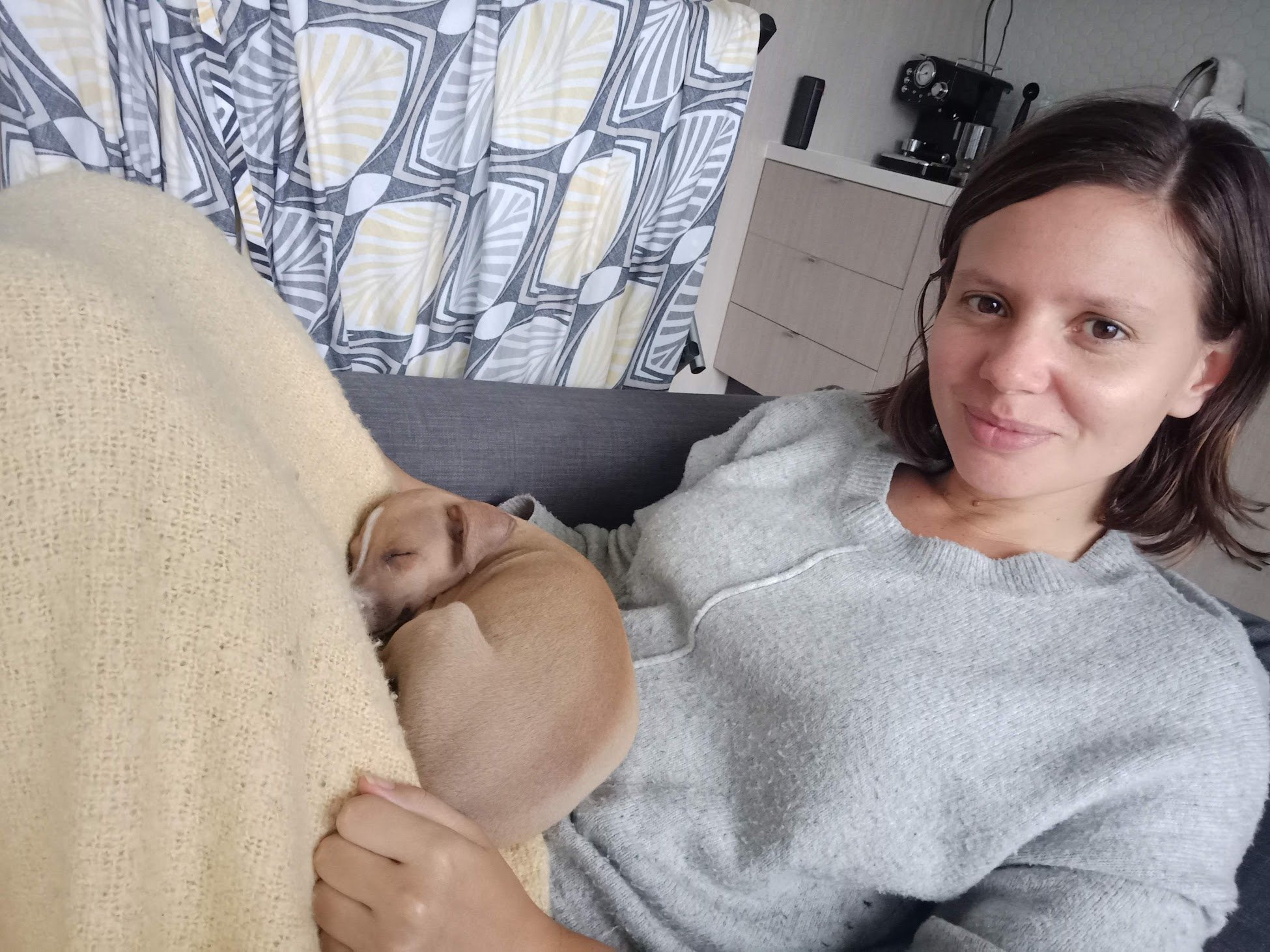
Warm couch puppy = heaven
There’s a solid body of research that suggests dogs can benefit humans. A large meta-analysis found that people who share their lives with dogs tend to live longer, particularly those recovering from heart disease. For instance, among people who lived alone after a heart attack, those with dogs had higher survival rates compared to those without.
On a hormonal level, spending time with dogs can influence the body’s chemistry in measurable ways. In one study, children and dogs who interacted affectionately both showed higher levels of oxytocin, the hormone linked to bonding and connection. Similar research shows adult dog-human pairs experience elevated oxytocin during even brief positive interaction.
Dogs often anchor our human routines: regular exercise, time in nature, cuddles on the couch (essential, no?). For many people, dogs provide structure, social connection, and deep comfort. And for those with disabilities, assistance dogs take that support even further, helping with daily tasks, mobility, and independence while also providing the same steady companionship that benefits so many of us.
Here’s where the “yes, but” comes in, or maybe it’s more of a “yes, and.” These benefits depend on context. They’re shaped by the quality of the relationship, the individual dog and human, the environment, and what life looks like day to day. Simply living under the same roof isn’t enough; it’s how we live together that counts.
Love with a side of exhaustion

Nana, a rescue who’d been abused and abandoned, was terrified of other dogs and being alone. Her incredible humans reshaped their lives to help her heal. I was honoured to be part of their journey.
Usually by the time people call someone like me, something in the relationship between them and their dog has broken down. After nearly fifteen years in this work, I’ve seen many ways that can happen.
Perhaps it’s a rescue dog who arrives with more trauma than anyone expected. Or someone who inherited a dog after a loss and is trying to carry grief and responsibility all at once. Perhaps it's parents who thought a puppy would complete the family and now spend their evenings peeling a screaming toddler off a chair while the puppy hangs from pyjama pants.
There’s the person walking a reactive dog, scanning every street corner, ducking behind cars, or diving into bushes to avoid another canine. Or the couple whose dog has separation anxiety, and whose social life has quietly disappeared along with their date nights.
These stories are everywhere. They live outside curated social media feeds, in the moments when good intentions collide with limited time and energy. Those moments often carry a lot of shame, too.
Research on pet-caregiver burden shows that people living with dogs who have behaviour problems often experience high levels of stress, guilt, and social withdrawal, and that this burden is common, not rare. The stress isn’t one-way either. Studies suggest that long-term stress levels in some dog–human pairs rise and fall together, hinting at shared emotional weather rather than separate storms.
So if you’re exhausted, or feeling guilty or isolated because life with your dog feels hard, that doesn’t make you a failure. It makes you normal. Caring about your dog doesn’t exempt you from frustration, fatigue, or high stakes. It just means you’re in the thick of sharing a life together.
Dogs aren’t here to fix us

A beautiful , heart-breaking dog from my time in rescue, expected to cope in a world that never truly considered what she needed.
In discussions about whether dogs are good for us, it’s easy to forget about the dogs themselves. Their experience gets buried between tales of saintly service dogs and the latest moral panic about “dangerous breeds.” When choosing a dog, we tend to focus on ourselves: the lifestyle we want to maintain, the breed we find beautiful, the behaviour we think we can manage. We tend to spend less time on “what will this dog need from me?” or “how will I need to change to make this work?”
Dogs are not therapists, tablets, or mindfulness apps with fur (I’m looking at you, puppy yoga). They are beings in their own right, with preferences, emotions, and a complex inner life. Living well with dogs means seeing them as partners, not projects. It also means making peace with the parts of dog behaviour that aren’t convenient for us. Yep, the barking, chewing, chasing, humping, and growling.
Anthrocentrism, the habit of viewing everything through a human lens, makes it easy to miss that. We measure dogs by what they give us, how they make us feel, and how well they fit into our homes. But if we want genuine connection, we have to shift the lens from what they offer to how they experience. That includes asking whether the lives we design for dogs are truly fair to them.
Not every dog is built for the world we’ve made. So many are bred for looks, or for lifestyles that no longer exist, or for human needs that don’t match canine welfare. When we buy or breed dogs who can’t breathe well, move comfortably, or cope with everyday life, we create suffering on both sides: dogs whose bodies or temperaments make their lives difficult, and humans stretched thin trying to care for them. That’s why I’m intrigued by groups like the Functional Dog Collaborative, who are trying to encourage ethical breeding and rehoming choices that put welfare before aesthetics.
It’s also why we should be wary of shaming people who face incredibly difficult choices. When a dog is deeply distressed, or when the relationship has broken down despite sustained effort and support, rehoming can sometimes be the most ethical path. “Forever homes” remain the goal, but so should honesty about what’s fair, safe, and humane for everyone involved.
Living well together when everything feels hard
It’s impossible to talk about caring for dogs without talking about the world we’re all trying to survive in. The cost of living rises while wages don’t. Public spaces shrink. The planet burns. And basic human rights, such as bodily autonomy, safety, and freedom of expression, are being chipped away by people who benefit from our exhaustion.
When everything feels precarious, it’s no wonder so many of us crave connection with dogs. They offer a kind of honesty and presence that can feel rare in human life right now. But it’s also no wonder that patience wears thin and guilt creeps in. We are asking humans to parent, partner, and provide for other species in a world that barely supports its own.
So I understand that when someone says “take care of yourself,” it can feel frustrating. Caring for ourselves and our dogs within this mess means recognising the systems that burn us out, and trying (where we can) to resist them. That might look like lowering the bar for perfection, or saying no to obedience culture that values compliance over wellbeing. It might mean forming small, quiet communities of care that keep both species afloat when the larger world feels hostile.
It also means rethinking what “enough” looks like. Maybe your dog doesn’t need more stimulation, but a calmer human. Maybe you don’t need a new training plan, but more sleep. Maybe you just need to name the emotions (tired, lonely, scared) and let that honesty soften how you respond to your dog.
If you can, build community on purpose. Find people who understand what you’re trying to do, who will remind you that empathy is a renewable resource only when shared.
Dogs were never meant to make us whole. They were meant to walk beside us through the brilliant and the difficult bits. If we can move beyond the story of dogs as effortless companions and ourselves as their benevolent keepers, we might finally begin the real work of living well together.
References
Barcelos, A.M. et al. (2023) ‘Dog owner mental health is associated with dog behavioural problems, dog care and dog-facilitated social interaction: a prospective cohort study’, Scientific Reports, 13(1).
Bauman, A. et al. (2020) ‘Does dog ownership really prolong survival? A revised meta-analysis and reappraisal of the evidence’, Circulation: Cardiovascular Quality and Outcomes, 13(10), e006907.
Beetz, A. et al. (2012) ‘Psychosocial and psychophysiological effects of human–animal interactions: the possible role of oxytocin’, Frontiers in Psychology, 3.
Gnanadesikan, G.E. et al. (2024) ‘Effects of human–animal interaction on salivary and urinary oxytocin in children and dogs’, Psychoneuroendocrinology, 169.
Kuntz, K. et al. (2023) ‘Assessment of caregiver burden in owners of dogs with behavioral problems and factors related to its presence’, Journal of Veterinary Behavior, 64–65, pp. 41–46.
Mubanga, M. et al. (2017) ‘Dog ownership and the risk of cardiovascular disease and death: a nationwide cohort study’, Scientific Reports, 7(1).
Sundman, A.-S. et al. (2019) ‘Long-term stress levels are synchronized in dogs and their owners’, Scientific Reports, 9(1).
