
Why Argos still breaks our hearts in The Odyssey
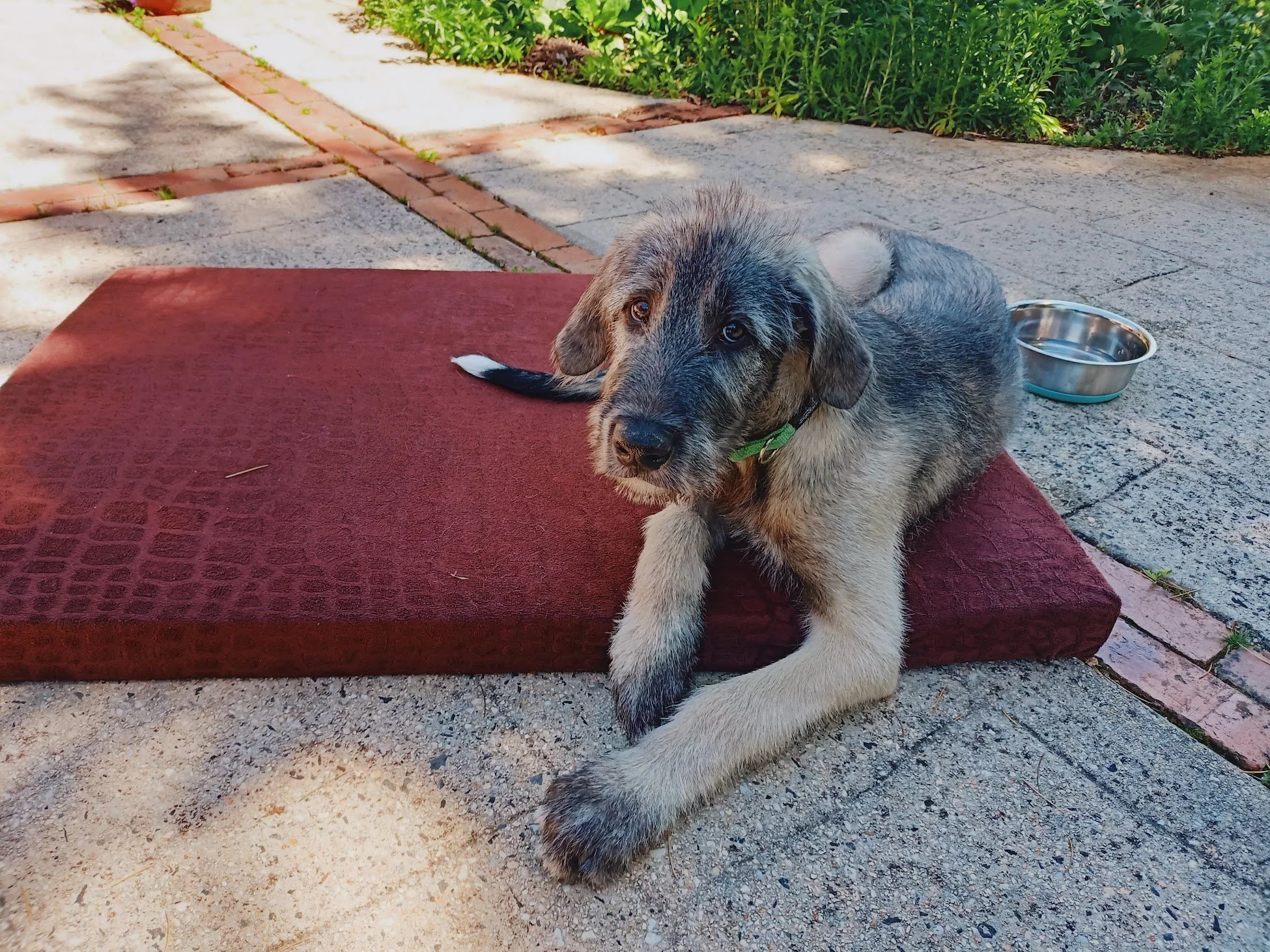
Finnegan, on the first day I met him. This article is dedicated to my parents’ beautiful Irish Wolfhound, who recently passed away. He had more than a little Argos about him, and knew and loved his people deeply.
Prior to my leap into the world of dogs and behaviour, I was a film nerd. I studied film as part of my undergraduate degree, and would stride about campus alongside the other slightly lost arts students, coffee in hand, shirt frequently and accidentally inside out as I scrambled, yet again, to get to my lectures on time. I was captivated by storytelling made real yet contained neatly on screen, ready for dissection and lively discussion. And even then, themes related to animals, or the ways animals were used figuratively in film, always grabbed my interest, or sometimes broke my heart (the discovery of doesthedogdie.com was definitely a useful one for me).
Last month I managed to fit in a solo viewing of Nolan’s The Odyssey while we were overseas. And the part that got me, naturally, was the moving depiction of Argos, Odysseus’s dog. Now, I’m not sure if spoiler alerts are needed for almost 3,000-year-old poems, but if you aren’t familiar with the story, consider yourself alerted.
In Homer’s foundational epic, Argos is Odysseus’s dog, raised before Odysseus leaves Ithaca to fight in the Trojan War. Before Odysseus leaves, Argos is described as a capable hunting dog, fast and skilled, which makes what comes later all the more tragic. Odysseus is gone for 20 years, and when he returns he disguises himself as a beggar. He isn’t recognised by the servants in his home, the suitors who have taken it over, or even, at first, by his wife Penelope. The exception to this is Argos.
As Odysseus approaches the palace, he finds Argos old, weak and neglected, lying on a manure heap. Argos has declined along with the household Odysseus left behind, and his body carries the cost of those missing twenty years. Argos recognises Odysseus immediately, drops his ears, wags his tail, and after seeing his person one last time, dies.
It’s a tiny moment in a huge story, but it’s one of the parts many people remember. There are plenty of examples of loyalty in The Odyssey, so I don’t think loyalty alone explains why the scene lands so hard. What feels especially powerful about Argos is the idea of recognition, and what survives beneath so much change. Odysseus’s appearance, status and circumstances have all changed dramatically, while Argos himself has been transformed by age and neglect. And yet somehow, across those twenty years, the recognition remains. To Argos, Odysseus is still entirely himself.
That idea has stayed with me because it opens up a bigger question I keep returning to: what does it actually mean to know another species?
Dogs know us in ways that are both intimate and slightly alien to our own experience. Their understanding of us isn’t built through the things humans tend to think define a person. They aren’t interested in job titles, reputations, whether we’ve had a productive day, or whether we’ve managed to look vaguely put together before leaving the house. They know our smell, the rhythm of our footsteps, the sound of our car, the way our body shifts before we stand up, the difference between the shoes that mean a walk and the ones that mean we’re leaving without them. They learn the repeated patterns of our lives with astonishing precision, and over time they become familiar with versions of us that are almost invisible to everyone else.
And we know them too. Living closely with a dog means becoming sensitive to a collection of tiny signals and habits that would mean very little to someone else. You know the particular look that means they need to go outside, the difference between a comfortable sprawl and a body that’s trying very hard to look relaxed, or the way their pace changes when something ahead has caught their attention. You know which sounds matter to them, which people they gravitate towards, which situations drain them, and when they’re approaching the point where they’ve had enough. Much of this knowledge simply accumulates through living together.
I find this level of co-existence quite remarkable at times. Two different species, with different sensory worlds, communication systems and priorities, somehow managing to build a shared existence out of repetition, observation and experience. We develop routines and expectations around one another. We learn what tends to happen next. We become deeply familiar.
And perhaps that familiarity becomes a kind of shared language in its own right. Not language in the human sense, obviously, but a system of meaning built slowly between particular individuals. A glance comes to mean something because it has happened a hundred times before. A certain movement towards the door becomes a request. A sigh, a pause, a shift in posture, the way someone reaches for a lead or turns towards the kitchen, all become part of a private catalogue of cues that make sense within that particular relationship. Over time, very little sometimes needs to happen for quite a lot to be communicated.
At the same time, I think there is something important in not becoming too confident about what we know. Familiarity can easily turn into certainty, and certainty is where we can start to get dogs wrong. We say things like “he knows he’s doing the wrong thing”, “she’s jealous”, “he’s being stubborn”, or “she loves everyone”, as though we have direct access to the motives behind the behaviour. But often these are anthropomorphic stories we create to make behaviour legible to us, especially when we don’t fully understand what’s driving it.
Living closely with a dog can teach us an enormous amount about them, but familiarity is not the same as complete understanding. Dogs still have sensory experiences, motivations and perceptions that we can only ever partly access. Knowing them well, then, may require a slightly uncomfortable kind of humility: holding on to what we have learned while leaving room for the possibility that our explanation is wrong.
I don’t think that uncertainty makes the relationship less intimate. If anything, I think it makes it more interesting. To know another species well is not to fully decode them. It’s to pay close enough attention that patterns emerge, while staying curious about what we might still be missing. A dog we have lived with for ten years can still surprise us. We can still notice something new about what they enjoy, what they avoid, what helps them feel safe, or how they have quietly been communicating something we had previously missed.
That’s one of the things I find most compelling about living with dogs. We become extraordinarily familiar to one another without ever becoming the same. There is always some small gap between our worlds, and yet somehow we build a life across it. And perhaps that’s what makes Argos’s recognition so moving. It demonstrates loyalty, certainly, and love too, but also something built through years of ordinary familiarity: the ability to know another being even when almost everything else has changed.
